



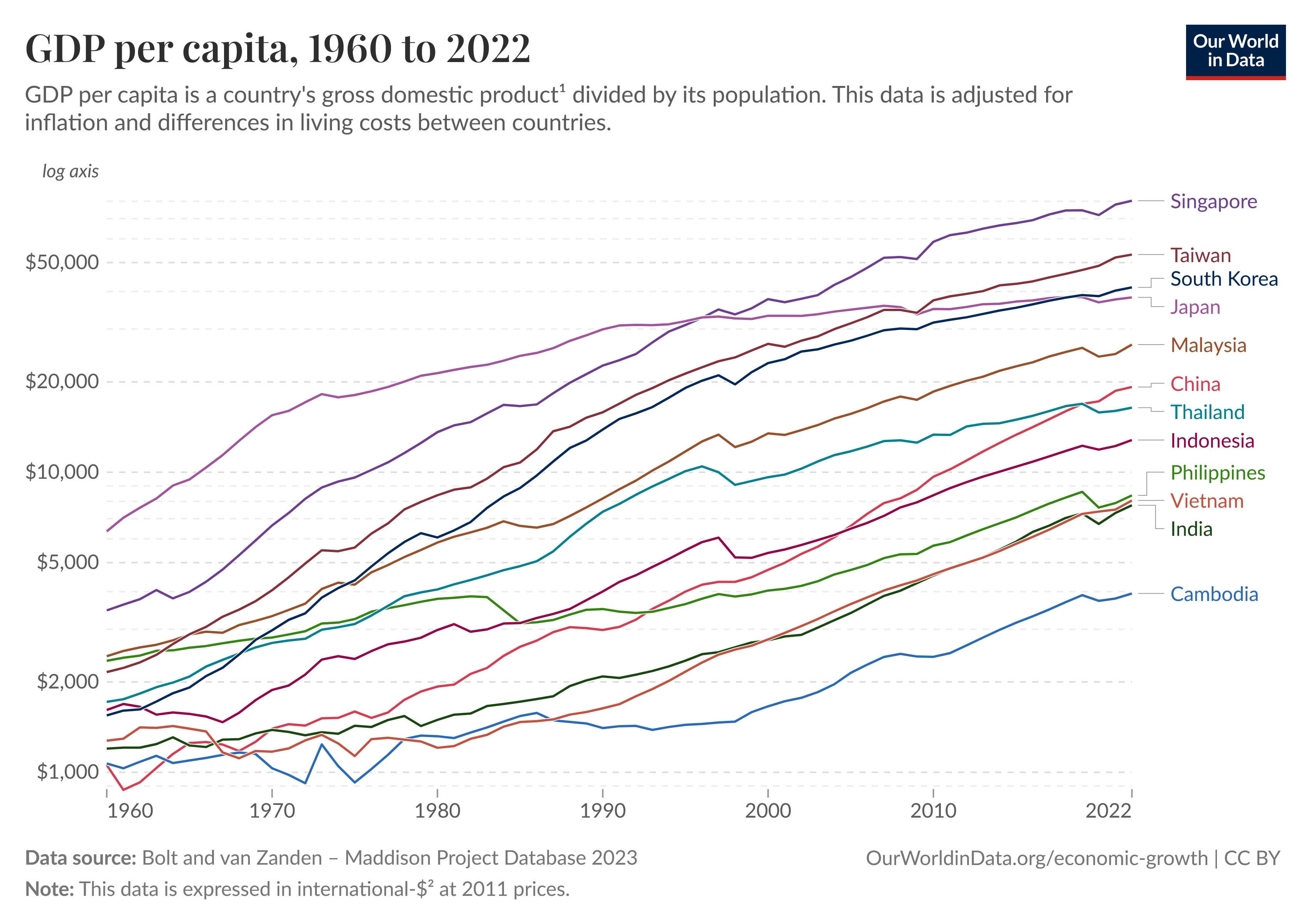
Here’s a question for you: In which economies do exports account for more than half of GDP? If you guessed Germany (41 percent) or China (20 percent), you’d be wrong. The answers are Vietnam (90 percent), Cambodia and Malaysia (70 percent), Thailand (60 percent) and Singapore – which, at 175 percent, exports more than it produces, the economic equivalent of a magic trick.
These aren’t merely export-oriented economies. They are the beating heart of globalisation. Strip away the flows of goods, capital and technology of the last five decades, and you strip away the Asian model itself. For more than 50 years, that model delivered the most compressed period of mass prosperity in human history. It rested on three pillars: open trade, a stable geopolitical order anchored by American power, and the assumption that technology would continue to flow from rich to poor countries, allowing catch-up growth.
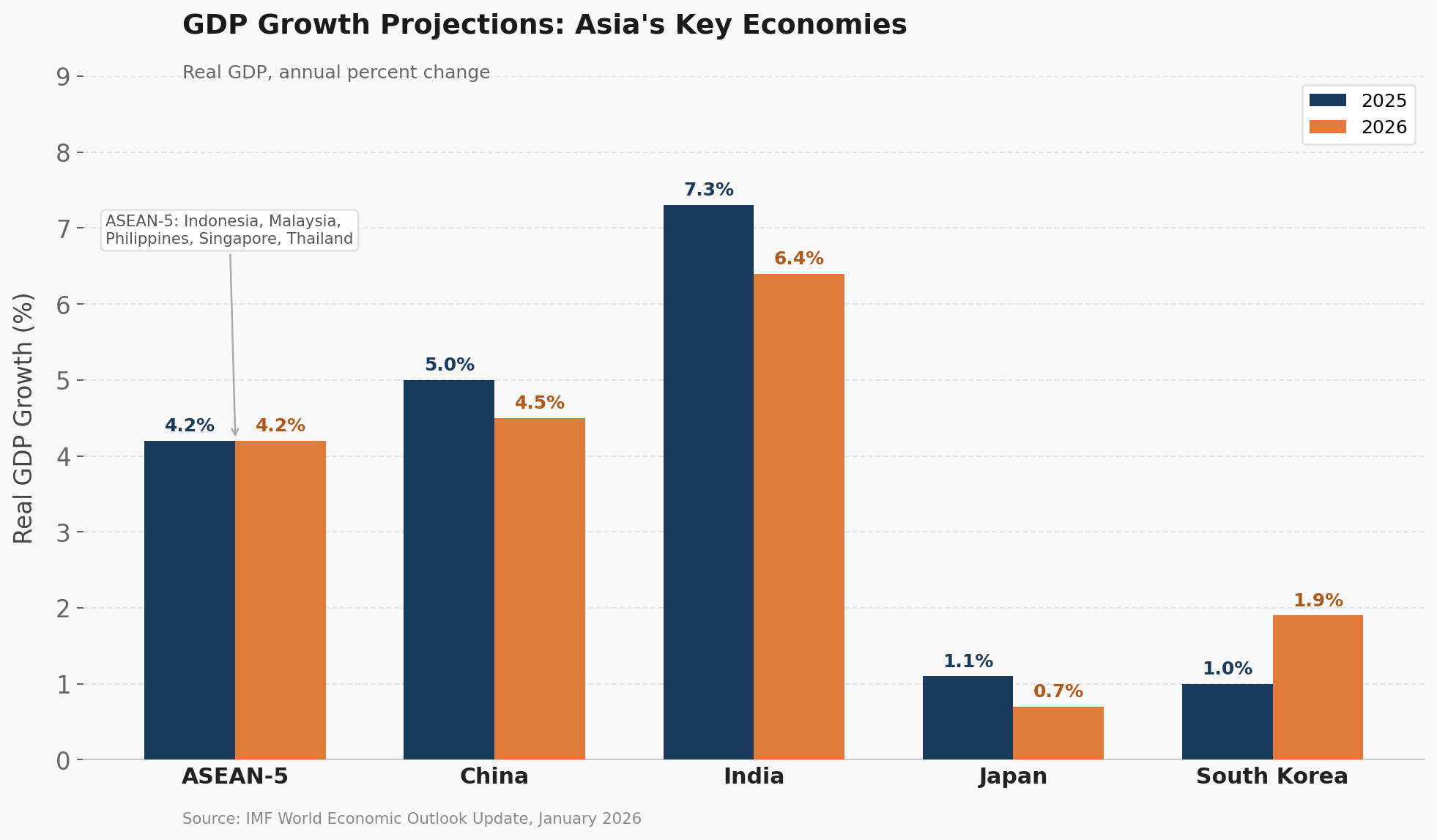
Unfortunately, all three pillars are currently under strain as the world undergoes a structural break. The break isn’t yet visible in headline growth numbers, which is precisely what makes it dangerous. The IMF projects that most of Asia will grow respectably through 2026. However, many factors that sustained GDP growth last year – tariff exemptions, TACO (Trump Always Chickens Out), stockpiling and the AI boom – may all wane in the years ahead, curtailing growth.
The trade pillar
Donald Trump’s first stint as President of the United States was annoying but manageable. Tariffs were narrow, targeted, telegraphed in advance and phased in slowly. Crucially, firms could plan for them, with many rerouting supply chains through Vietnam and Malaysia. Trump 2.0 is different. The tariffs are sudden, volatile, whimsical and coercive. Unpredictability is a feature, not a bug. The current conflict in the Middle East has only deepened the sense of chaos and uncertainty.
After the tariffs were announced last year, countries raced to strike deals: Vietnam accepted 20-percent tariffs in exchange for zero tariffs on its goods and commitments to buy American liquefied natural gas and aircraft. Malaysia agreed to 19-percent tariffs, giving Washington a say over its export controls. Japan and Korea got 15 percent in exchange for investment pledges, while Singapore, despite its free trade pact with the US, quietly accepted a 10-percent baseline tariff.
Last month, the Supreme Court stepped in and deemed these tariffs unconstitutional. Almost immediately, Trump invoked presidential powers under a 1974 trade law to impose blanket 15-percent global tariffs. Everyone now gets 15 percent, and the trade deals and bilateral concessions, extracted under duress, are in limbo. Some will be slow-walked, some renegotiated, others reneged on. However, even these tariffs are likely illegal, as they are used to address balance-of-payments issues that the US simply doesn’t face. They expire in 150 days, and what happens after that is anyone’s guess.
Beyond tariffs, the more immediate threat is transhipment. Goods in Asian supply chains cross borders an average of six times before becoming a final product. Transhipment tariffs of 40 percent, designed to prevent rerouting and reclassification, expose Singapore, Vietnam and Thailand to a compliance nightmare they are only beginning to map. The advice for companies is to invest heavily in data, trace what fraction of your inputs originate from each source, and prepare for rules that will change before the compliance systems are built.
Indonesia's position deserves a separate note. Its 2020 nickel ore export ban was a device to force Chinese and Western battery manufacturers to invest in downstream processing within Indonesia. It didn’t want to be an upstream commodity exporter, susceptible to the resource curse and Dutch disease of deindustrialisation. In fact, it wanted the entire value chain. The complication is that Chinese firms currently control an estimated 70 to 80 percent of Indonesia’s nickel processing capacity. The mineral is Indonesian; the value chain is largely not. Battery facilities have been slow to ramp up, while Chinese electric vehicle manufacturers are shifting to battery chemistries that use far less nickel.
The geopolitical pillar
Japan and South Korea built their entire defence posture around one assumption: that the American security umbrella would be deployed in times of need. That assumption is now a question mark. The recent behaviour of the Trump administration – the Venezuela operation, the Greenland threats, the treatment of NATO allies as supplicants rather than partners – has communicated something specific to every Asian capital: Sovereignty has a price, and the US no longer considers itself unconditionally bound by the architecture it built.
The Taiwan issue concentrates this anxiety. A recent article in The New York Times put a number on what a Taiwan crisis would cost: an 11-percent decline in US GDP, while China’s economy would contract by 16 percent. Taiwan produces roughly 90 percent of the world’s high-end chips and underpins an estimated US$10 trillion of global GDP. Such a scenario would not merely threaten its flagship chipmaker TSMC; it would detonate the entire regional supply chain, including Singapore, Malaysia, Vietnam, Thailand and the Philippines.
ASEAN countries don’t primarily buy from TSMC to consume chips. Rather, they sit downstream of it, specialising in the assembly, testing and packaging (ATP) of chips before re-export to end markets globally. In 2024, Taiwan exported close to US$40 billion in semiconductors and components to ASEAN. Roughly 80 percent of these exports flowed to Singapore and Malaysia alone.
The two countries differ in an important way, however. Malaysia remains almost entirely a back-end operation: It handles global chip ATP but produces almost no wafers itself. Singapore is further up the value chain and hosts multiple active wafer fabrication plants, or fabs, with more under construction. But even in Singapore, the fabs are foreign-owned and dependent on an unbroken supply of wafers and equipment from Taiwan, the Netherlands and the US.
What makes this especially uncomfortable is that ASEAN is exposed to the downside of both the current system and the transition away from it. A Taiwan crisis would cut off inputs. But a successful American reshoring effort (the Trump administration is pushing for 50 percent of chips to be made on US soil) would also shrink the flow of Taiwanese inputs through Asian ATP hubs.
The question ASEAN planners aren’t yet asking loudly enough is: What is our exposure not to a Taiwan invasion, but to a Taiwan disruption – elevated tensions before any shots are fired, when shipping insurance spikes, investment freezes, flows of chips are disrupted, and the great powers start asking smaller states whose side they are on?
The AI technology pillar
An AI Impact Summit was organised in India just last month. The summit dismissed the idea of “superintelligence soon” as an American imperialist narrative and instead bet on the diffusion of small models, open-source models and the need for some edge compute. This may be right. But what if it happens to be wrong?
American hyperscalers including Microsoft, Google, Meta and Amazon collectively committed over US$300 billion to AI capital expenditure in 2025 and US$690 billion in 2026. The Stargate Project alone commands US$500 billion over four years. These are investments in recursively self-improving systems and building “god in a box”. Again, it’s right to question the fragility and sustainability of this investment and lament the relentless AI hype. Then again, Claude Cowork and Claude Code wiped out US$300 billion in software company valuations in a week!
Against this, Singapore’s recent commitment of S$1 billion over five years to its national AI strategy is a rounding error. This isn’t a criticism of the city-state; it simply can’t match American numbers. The question is whether "good enough" local models will be sufficient as the frontier accelerates, or whether economies that make this bet find themselves locked into technological dependence on whoever controls frontier systems – almost certainly either the US or China – at precisely the moment when AI-driven productivity gains are widening the gap between frontier and non-frontier economies faster than any previous technology.
China is exerting a different kind of pressure. Its relentless application of AI-enabled automation in manufacturing has compressed the low-cost labour advantage that Vietnam, Thailand, Indonesia, the Philippines and India are counting on. Robot density in Chinese manufacturing rose from 25 per 10,000 workers in 2015 to roughly 392 in 2023 – nearly matching Germany, the world’s most automated large manufacturing economy. The window for labour-cost-based manufacturing competition may be closing faster than anyone in Jakarta or New Delhi is prepared to acknowledge.
India’s position is the most paradoxical. Its US$250 billion IT services sector, employing five million people, was built on one comparative advantage: large numbers of English-speaking engineers who could do, at lower cost, what Western firms needed. That advantage is being structurally eroded by the very AI systems India now hopes to deploy for growth. And it’s being built by the major AI companies, staffed and often led by Indians. The middle rung of the ladder is being pulled up while the climbers are still on it.
My fear is not that AI disrupts. Every technology disrupts. My fear is that the disruption arrives before the adaptation does, and that governments currently building five-year AI roadmaps premised on a plateau that may not materialise will look up in 2028 and find that the world they planned for no longer exists.
The Asian trilemma
Every piece about Asia in crisis is supposed to end on a positive note, with every challenge reframed as an opportunity. But sometimes, a crisis is just a crisis. And compulsory or compulsive optimism is a form of denial.
The threats to Malaysia and Singapore in semiconductors and to Japan and South Korea on security are real. So are the opportunities for India and Indonesia. The fracturing of the China-centric supply chain creates space. The demand for alternative manufacturing bases, mineral suppliers and technology partners is genuine. But the opportunity is narrow, time-bound and conditional on decisions that no government has fully committed to: continued investment in logistics, reforms and state capacity in India’s case, diversification away from Chinese processing dominance in Indonesia’s.
The Asian miracle was built on the assumption that the system would hold. The trilemma is the likelihood that it won’t. What is new for firms and governments in this region is that the pillars are cracking, and the pivot has to happen faster than the displacement.
Read a longer version of this article.
Edited by:
Rachel Eva Lim-
View Comments
-
Leave a Comment
Related Reads

Economics & Finance
Fracas in Caracas: Redrawing the Lines

Economics & Finance
Will Trump Unite India and China?

Economics & Finance
No comments yet.